 logo
logo



Search behavior has changed over the last few years. Today, users don’t just type keywords and look for answers; they ask AI search engines detailed questions, compare sources, and expect instant answers. This shift has made search engine optimization more intent-driven than ever before.
There are businesses that still follow a generic SEO approach regardless of whether they sell to other businesses or directly to customers. That’s a costly mistake.
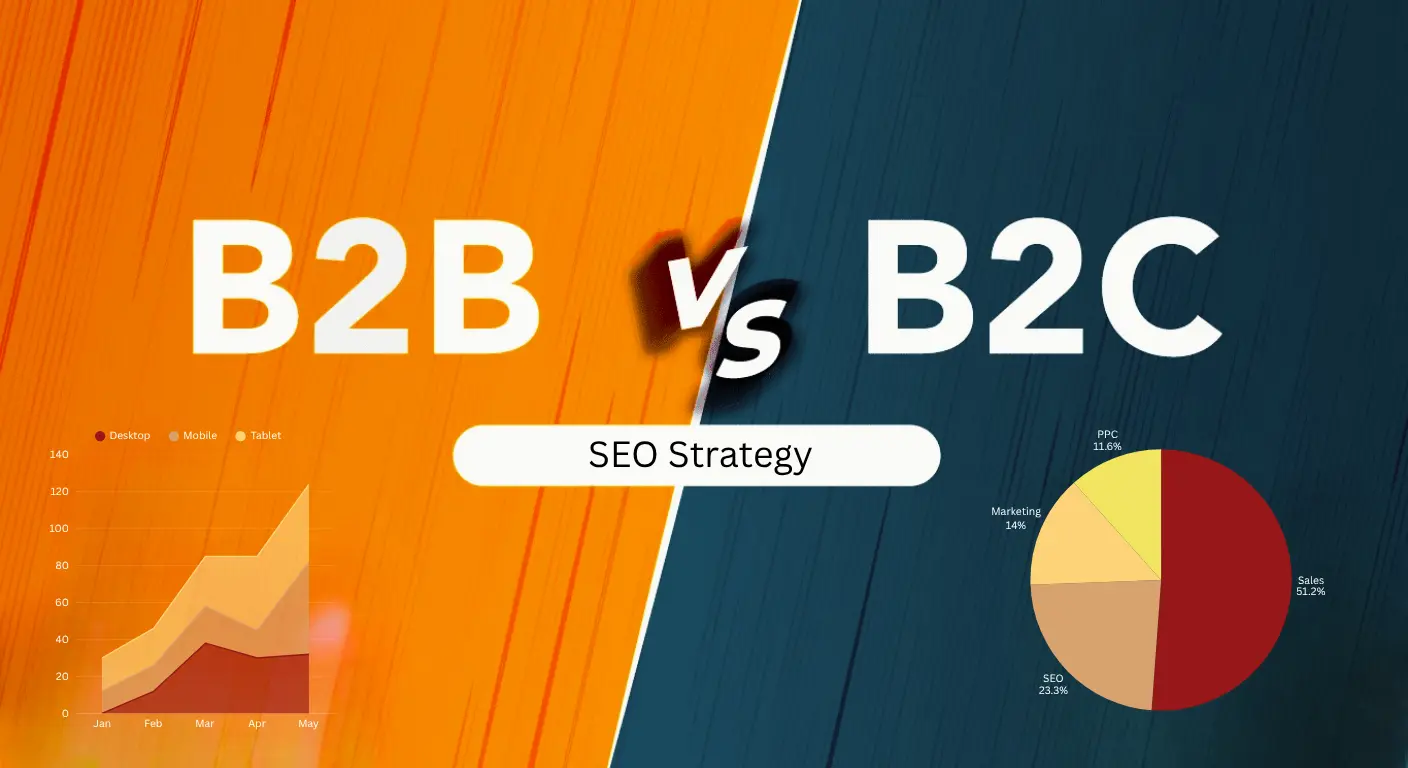
The B2B vs B2C SEO debate isn’t about choosing one strategy over the other; it is about recognizing that audiences search and consume content differently.
Whether your goal is generating leads or increasing online sales it is important to understand the difference in audience needs.
What is B2B SEO?
B2B SEO focuses on improving a website’s visibility for businesses to address operational and commercial challenges. Unlike consumer purchases, B2B buying decisions revolve around multiple stakeholders, detailed evaluations, procurement processes, and larger investments. Buyers expect expertise, data-backed insights, and confidence before requesting a demo. What does an effective B2B SEO strategy look like:
- Attract decision-makers with high purchase intent
- Build authority within the niche
- Educate prospects throughout their buying journey
- Generate qualified leads rather than traffic
- Support sales teams with valuable informational content
Success in B2B SEO is measured by lead quality, long-term customer acquisition, and pipeline growth.
What is B2C SEO?
B2C SEO is here to help businesses reach individual consumers who are looking to purchase products or services for personal use. Consumers’ buying journeys are shorter and more emotionally driven. People often compare prices, read reviews, check product features, and make decisions within a single browsing session. This is what a successful B2C SEO strategy focuses on:
- Ranking high-volume commercial keywords
- Optimizing product and category pages
- Improving user experiences across devices
- Reducing purchase friction
- Increasing online sales and conversion
The emphasis is on making discovery and purchasing easier.
Difference between B2B and B2C SEO
Both of the strategies share the same technical SEO fundamentals, but the difference between B2B and B2C SEO lies in how they address audience intent and business objectives.
| Factor | B2B SEO | B2C SEO |
| Target audience | Businesses | Individual consumers |
| Buying journey | Long and research-loaded | Short and purchase-focused |
| Decision makers | Multiple stakeholders | Single buyer or family |
| Search intent | Educational and solution-focused | Commercial and transactional |
| Content style | In-depth and authoritative | Concise, engaging, and persuasive |
| Primary goal | Lead generation | Product and service sales |
| Conversion timeline | Weeks or months | Minutes or days |
Businesses that sync their SEO efforts with these differences attract relevant visitors and achieve conversion fastest.
Why does search intent shape every SEO decision?
Search intent is the base of modern SEO. The following example justifies:
- B2B searches
- ERP software for manufacturing
- CRM for healthcare providers
- AI-powered workflow automation
- Cybersecurity compliance solutions
These indicate that users are researching complex solutions before making significant investments.
Now, let’s compare them with B2C Searches:
- Best gaming laptop
- Buy running shoes online
- Affordable skincare products
- Coffee shops near me
These users are closer to closing their purchase.
Google and AI engines prioritise content that directly address the intent behind each query. A page designed for enterprise buyers will never satisfy someone who is looking to purchase a consumer product, and vice versa.
Keyword Strategy: Quality over Quantity
Businesses make costly mistakes by targeting keywords based on search volume. A strong B2B SEO strategy prioritises highly relevant, low-competition keywords that attract qualified business prospects. For example:
- Manufacturing ERP software
- Enterprise cybersecurity platform
- Cloud accounting for healthcare
- HR management software for startups
The above keywords generate fewer searches but often produce valuable leads.
B2C SEO targets broader commercial keywords like:
- Best smartphones
- Home gym equipment
- Winter jackers
- Wireless earphones
The above keywords attract larger audiences but also require stronger competition strategies. The objective isn’t to attract the visitors, it is to attract visitors who are most likely to convert.
Content Strategy: Educating vs Selling
| Content Type | Focus | Formats | Goal |
| B2C Content | Consumer-focused to help users make quick purchase decision | Buying guides, product review, comparison articles, gift ideas, frequently asked questions, video demonstrations, and product tutorials. | To convert from add-to-cart actions, store visits, coupon downloads, and subscription purchase |
| B2B Content | Focused on informating consumer to make right choice through their knowledge | Industry guides, case studies, whitepapers, research reports, product comparisons, ROI calculators, and technical documentation | Building expertise and trust throughout |
Why do AEO and GEO talk more than SEO?
Search engines are no longer the same, because the users are evolving. Users are asking conversational questions via AI platforms such as Google AI Overviews, Gemini, ChatGPT, and Perplexity. To remain visible, businesses need content that is optimized for their search engine and generative AI. That’s where Answer Engine Optimization (AEO) and Generative Engine Optimization (GEO) become important. Be it implementing a B2B SEO strategy or a B2C SEO strategy, your content should:
- Answer user questions directly
- Include clear headings and structured formatting
- Demonstrate expertise with credible information
- Cover topics comprehensively
- Use internal linking to strengthen topical authority
- Include schema markup where appropriate
This approach improves visibility across both traditional search engines and AI-powered search experiences.
Building the Right SEO Strategy
An effective B2B SEO strategy should prioritize:
- High-intent industry keywords
- Comprehensive educational content
- Thought leadership
- Case studies and client success stories
- Technical SEO
- Lead generation optimization
A successful B2C SEO strategy should focus on:
- Transactional keyword targeting
- Product page optimization
- Mobile-first user experience
- Fast-loading websites
- Strong calls to action
- Streamlined conversion paths
Applying the same SEO framework to both audiences often leads to missed opportunities and lower ROI.
Final Thoughts
Whether you’re targeting enterprise decision-makers or everyday consumers, your SEO strategy should be built around how your audience searches, evaluates, and converts, not just around keywords.
At BizClick Digital, we help businesses develop customized B2B SEO and B2C SEO strategies that combine Technical SEO, high-quality content, Answer Engine Optimization (AEO), and Generative Engine Optimization (GEO) to improve visibility across Google, AI-powered search, and answer engines. Our focus is on driving qualified traffic, increasing conversions, and delivering measurable business growth.
If you’re ready to outrank your competitors and build a future-ready SEO strategy, get in touch with the experts at BizClick Digital today. Explore our SEO Services, request a Free SEO Consultation, or Contact Us to discover how we can help your business achieve sustainable organic growth.
