 logo
logo

Introduction
Today, when you type a question into Google search, there is a decent chance you never scroll past the first screen. An AI-written summary already answers your question. Ask the same question in ChatGPT or Perplexity, and there’s no result page at all- just an answer for you, prepared together with the sources you’ll probably never click.
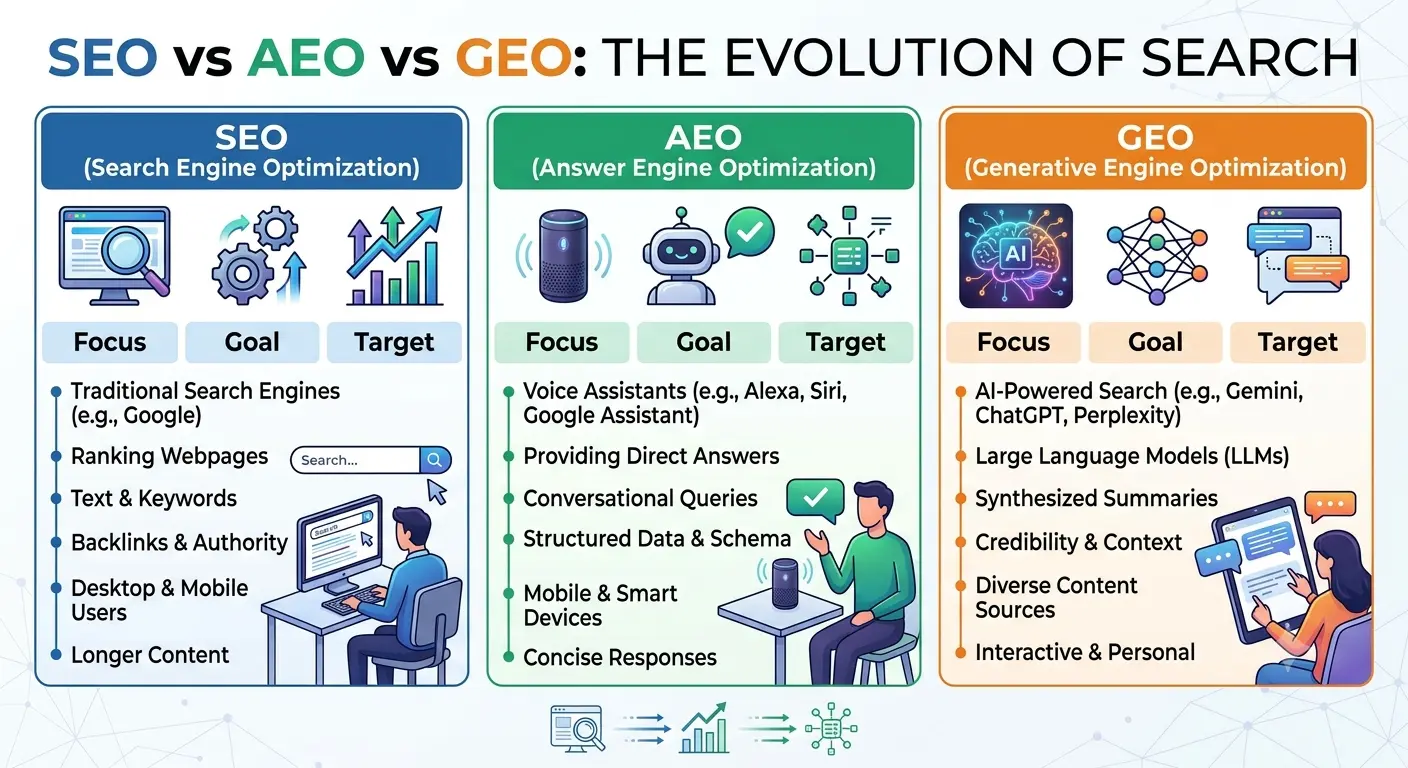
This is the world that AEO vs GEO vs SEO is trying to describe. The three acronyms change your brand visibility game in three distinct ways, yet many marketers still treat them as one. Let’s break down this thought and outline the differences for clarity.
The Three Layers- SEO, AEO, GEO
| Pointers | SEO | AEO | GEO |
| Full form | Search Engine Optimization | Answer Engine Optimization | Generative Engine Optimization |
| Primary goal | Rank higher in the search results | Get selected as the direct answer in the Google AI answer section. | Get cited inside AI-generated responses. |
| Where it shows up | Google, Bing, Yahoo result pages | Featured snippets, AI overviews, voice assistants, PAA boxes | ChatGPT, Claude, Gemini, Perplexity |
| Success metrics | Rankings, organic traffic, clicks | Snippet/answer-box appearances, voice results | AI citation share, brand mentions in AI answers |
| Core tactics | Backlinks, technical SEO, on-page keywords | FAQ schema, conversational Q&A formatting, concise answers | Entity-rich content, original data, authorship signals, credible sourcing |
| User results | Click through to the website | Get the answer instantly, may or may not click | Get your information via the AI’s answer, often without a click |
| Best for | Business needing foundational visibility | Service, SaaS, and expert brands competing for snippets | Brands building authority inside AI search engines and buying journeys |
SEO- Is Still the Foundation
SEO is the discipline that every marketer knows by heart- improving a website’s technical health, content relevance, and authority so it ranks on Google, Bing, and other search engines. SEO toolkit basically includes these, which haven’t changed much in twenty years:
- Site speed
- Crawlability
- Keyword-relevant pages
- Backlinks
- Meta tags
What changed is what happens after you rank. SEO’s job is to win the click for your website. Now, ranking well is table stakes rather than the finish line.
AEO- Becomes an Answer, without click
AEO structures your content to show directly inside AI overviews, featured snippets, People Also Ask Boxes, and voice responses. Instead of competing for a click, you’re competing to be the answer someone reads without scrolling further.
That distinction has power. AI overviews appear across a large share of informational searches, and their presence suppresses click-through to the sites underneath them. AEO responds with clear, scannable structure: tight definitions, FAQ formatting, and schema markup that makes an answer easy for a machine to extract. AEO toolkit basically includes:
- To-the-point, extractable definitions
- FAQ style formatting and schema markup
- Conversational, question-led headings
- Content structured to answer one clear question per section
GEO- The Most Ignored One
GEO is new, and it works differently. It’s the practice of shaping content so large language models- ChatGPT, Claude, Gemini, Perplexity treat it as trustworthy enough to cite when generating a response.
A search engine hands back a ranked list. A generative engine synthesizes the answer from several sources and names only a handful. The scale in GEO is hard to ignore. ChatGPT alone handles billions of prompts daily, most of which function as search queries, and a growing share of people now start research inside an AI chat window instead of the search bar. GEO toolkit includes;
- Entity-rich content
- Visible credentials and authorship
- Original data and research
- A citation footprint across the web
- Clean, machine-readable structure
- Consistency across sources
The Metrics BizClick Digital Includes in Every AI SEO Strategy Report
Most brands keep watching the same dashboard while the ground shifts underneath it. Organic sessions and keyword positions matter, but they only tell part of the story in 2026. A page still loses its traffic while quietly winning ground in AI-driven discovery, and you won’t see it unless you’re tracking for it. A few numbers worth adding as part of a broader
AI SEO strategy to your marketing report post AEO and GEO introduction:
- AI citation- Share how often your brand gets referenced when someone asks ChatGPT, Perplexity, or Gemini a question in your category. Tools built for AI visibility tracking can surface this; manual spot-checking with a rotating set of prompts works too.
- AI overview appearance rate- Share whether your content is being pulled into Google’s AI-generated summaries, even when it doesn’t produce a click.
- Referral traffic from AI platforms: Check your analytics for traffic from chat.openai.com, perplexity.ai, and similar domains. It usually shows a small number today, but growing faster than anything else.
- Zero-click impression value: How many times your information gets shown or referenced without anyone visiting your site.
If you’re only reporting your rankings and sessions, you’re likely under- or over-selling your actual visibility. Some brands are performing far better than their traffic number suggests. Others look fine on paper while quietly losing ground in every AI-driven conversation.
To Conclude
Your brands need all three, but not at once; eventually. Building from scratch, fix the SEO foundation first- technical health, indexability, topical authority. Once you’re ranking decently, layer in AEO. Restructure your strongest pages into direct-answer formats with proper schema. GEO is the next. It is built on authority you’ve already earned, reinforced by original research, credible sourcing, and consistent presence across the web that an AI system learns to trust over time.
Still got some questions about AEO vs GEO vs SEO? Connect with BizClick Digital experts and leave a valuable impact in all three.
